New โฆ
IEEE WF-IoT 2026
2026
PAN-AQI: A Panoramic Dataset and Framework for Urban Air Quality Estimation
Ansh Shah, Om Kathalkar, Sachin Chaudhari, Anoop Namboodiri
Image-based air quality estimation offers a scalable alternative to sparse sensor-based monitoring. To address limitations of narrow field-of-view imagery, we introduce PAN-AQI โ a large-scale dataset comprising 33,982 panoramic 360ยฐ street-view images collected over 18 days and 1000 km across Hyderabad and Secunderabad, India, with co-located PMโ.โ
, PMโโ, Temperature, and Humidity measurements. We further propose PANQIFormer, a multimodal transformer framework combining spatial-zone reasoning, attention-based multimodal fusion, and ordinal-aware learning for both AQI category classification and continuous AQI regression. PANQIFormer achieves consistent improvements over prior methods, reducing AQI MAE from 21.59 to 10.45. Together, PAN-AQI and PANQIFormer establish panoramic sensing as a promising direction for vision-based air-quality monitoring.
Springer Nature
2026
Network-aware Path Planning for AMRs: A Generalizable Framework with Spatial-aware Adaptation
Om Kathalkar, Houssam Hajj Hassan, Ajay Kattepur, Georgios Bouloukakis
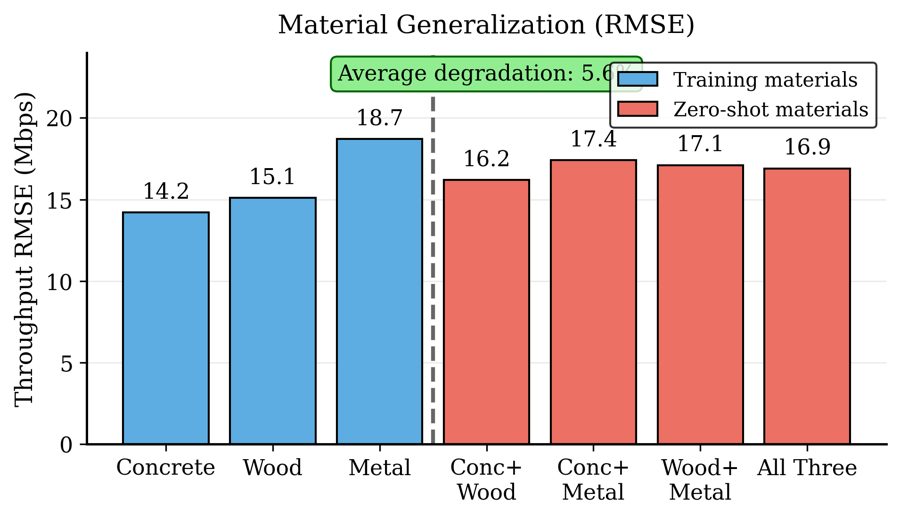
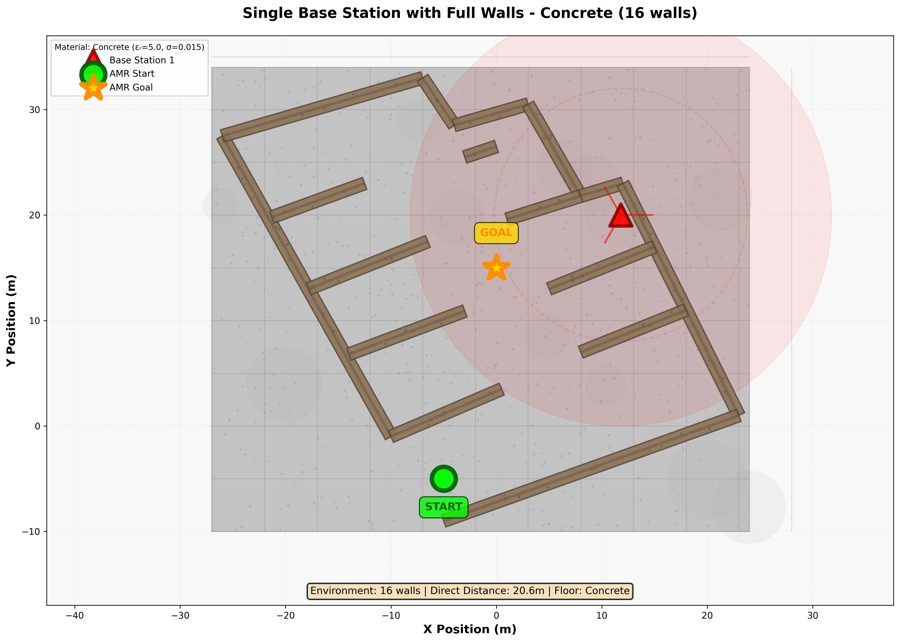
Industrial autonomous mobile robots increasingly depend on reliable wireless connectivity for real-time control and data streaming, yet existing path planning methods fail to account for the complex interplay between spatial geometries and material-dependent signal propagation. This paper presents a spatial-aware transformer framework for network quality prediction that explicitly encodes both geometric layouts and electromagnetic properties of building materials. Validation against the iV2I+ real-world dataset achieved Rยฒ=0.87 for SNR predictions. Evaluation across 8,840 test paths demonstrated SNR prediction RMSE of 2.31 dB (Rยฒ=0.891), a 19.5% improvement over state-of-the-art baselines. Zero-shot evaluation on mixed-material scenarios yielded only 10% performance degradation, eliminating facility-specific retraining.
IEEE ANTS 2025
2025
Om Kathalkar, Houssam Hajj Hassan, Ajay Kattepur, Georgios Bouloukakis
AMRs in industrial environments require reliable wireless connectivity for coordination, control, and safety operations. This paper presents a framework for network-aware path planning incorporating wireless network quality metrics as path constraints. Sionna-based ray-tracing simulations are validated against real-world measurements (Rยฒ=0.87 for SNR, 0.82 for throughput). Three planners were implemented: A* with network constraints, CVAE-based neural path planning, and GNN-based multi-path planning. CVAE achieved 95.2% constraint satisfaction; GraphMP showed 23% shorter planning times.
ICVGIP 2025
2025
Om Kathalkar, Nitin Nilesh, Sachin Chaudhari, Anoop Namboodiri
AQIFormer is a transformer-based ensemble architecture addressing cross-city generalization in image-based air quality estimation. Through innovative dual-view integration, weather-aware attention mechanisms, and multi-task learning, it combines front and rear traffic imagery with meteorological parameters. Evaluated on 26,678 synchronized image pairs, achieving 89.96% accuracy โ a 14.96% improvement over state-of-the-art. Cross-city generalization on an independent Nagpur dataset achieves 81.67% accuracy with only 8.29% performance degradation using few-shot adaptation.
ICVGIP 2024 Spotlight
2024
Om Kathalkar, Nitin Nilesh, Sachin Chaudhari, Anoop Namboodiri
TRAQID is a novel dataset of 26,678 synchronized front and rear traffic images with co-located weather parameters, PMโ.โ
, PMโโ levels, and six-category AQI values. Collected over 70+ hours across Hyderabad and Secunderabad, India, spanning multiple seasons with diverse day/night imagery under unstructured traffic conditions. Establishes a challenging benchmark for image-based AQI estimation.
EnvSys 2023
2023
Sara Spanddhana, Andrew Rebeiro-Hargrave, Om Kathalkar, Samu Varjonen, Sachin Chaudhari, Sasu Tarkoma
A protocol for using mobile search agents to identify PMโ.โ
emission hotspots in urban environments using IoT devices mounted on a mobile platform. Applied to Hyderabad, India, identifying short-range variability of PMโ.โ
using IoT sensing calibrated against a reference instrument. Random forest regression was most effective for calibration. The approach can be applied to any mobile platform โ walkers, cyclists, drones, or robots.
FiCloud 2022
2022
K. S. Viswanadh, Om Kathalkar, Nitin Nilesh, Sachin Chaudhari, Venkatesh Choppella
Remote Triggered Labs (RTL) enable students to conduct laboratory experiments virtually. This paper demonstrates computer vision-based RTL for the Conservation of Mechanical Energy experiment. Linear regression applied to the CV-based implementation achieved optimal MSE approximately 10ร better than the IR-based approach, validating CV as a scalable solution for remote laboratory access.
Indian Patent
2025
System for Determining Air Quality Index (AQI) in Urban Environments
Om Kathalkar, Ansh Shah, Sachin Chaudhari, Anoop Namboodiri
A system for accurately determining AQI in urban environments with high spatial and temporal variability. Includes a mobile platform with multi-camera data acquisition (front, rear, 360ยฐ), PMโ.โ
/PMโโ sensors, noise sensors, and contextual sensors. An edge computing device processes data using deep learning pipelines and a transformer-based encoder with multi-head attention for six-category AQI classification.
Indian Patent
2024
System and Method for Determining Air Quality by Processing Environmental and Traffic-Related Visual Data
Om Kathalkar, Nitin Nilesh, Sachin Chaudhari, Anoop Namboodiri
Automated AQI determination using multimodal data fusion and a transformer-based deep learning architecture. Receives synchronized video streams from two cameras with environmental sensor data. Features extracted via a frozen CNN are combined with sensor readings and contextual metadata, then fed into a custom transformer for six-category AQI classification.
US Patent
2024
Om Kathalkar, Nitin Nilesh, Sachin Chaudhari, Venkatesh Choppella
A remote laboratory system that uses computer vision to evaluate and grade physics experiments conducted remotely. Captures experimental setups via camera, applies CV models to determine physical outputs (velocity, trajectory), and compares against expected values โ enabling scalable, sensor-free remote laboratory access.